Topics / Romance & Confidence Scams
Romance & Confidence Scams Podcasts
8 shows and 891 episodes sit under Romance & Confidence Scams.
The best serialized scam and confidence-fraud podcasts: The Dropout (Theranos), The Missing Cryptoqueen (OneCoin), Exit Scam (QuadrigaCX), Queen of the Con, and more
Swipe · Romance & Confidence Scams only
Swipe through Romance & Confidence Scams
Save time discovering your next favourite podcast by listening to just the best minute of an episode.
The romance & confidence scams slate · every cover a link
All 8 romance & confidence scams shows →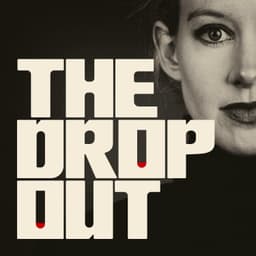




Next to this on the shelf
Every subtopic on this beat
The beat, written
What is actually on this beat
A promise lands first. Then comes the pause: a detail that will not fit, a debt that needs explaining, a person who is always almost ready to arrive. The strongest podcasts in this corner of true crime let that unease gather slowly. They understand that persuasion is the action.
That makes voice unusually important. A clinical reconstruction can expose the machinery, while an intimate narrator can show why the story held together for so long. Some shows stay close to the people inside the deception; others follow documents, money and increasingly improbable explanations.
Inside the relationship
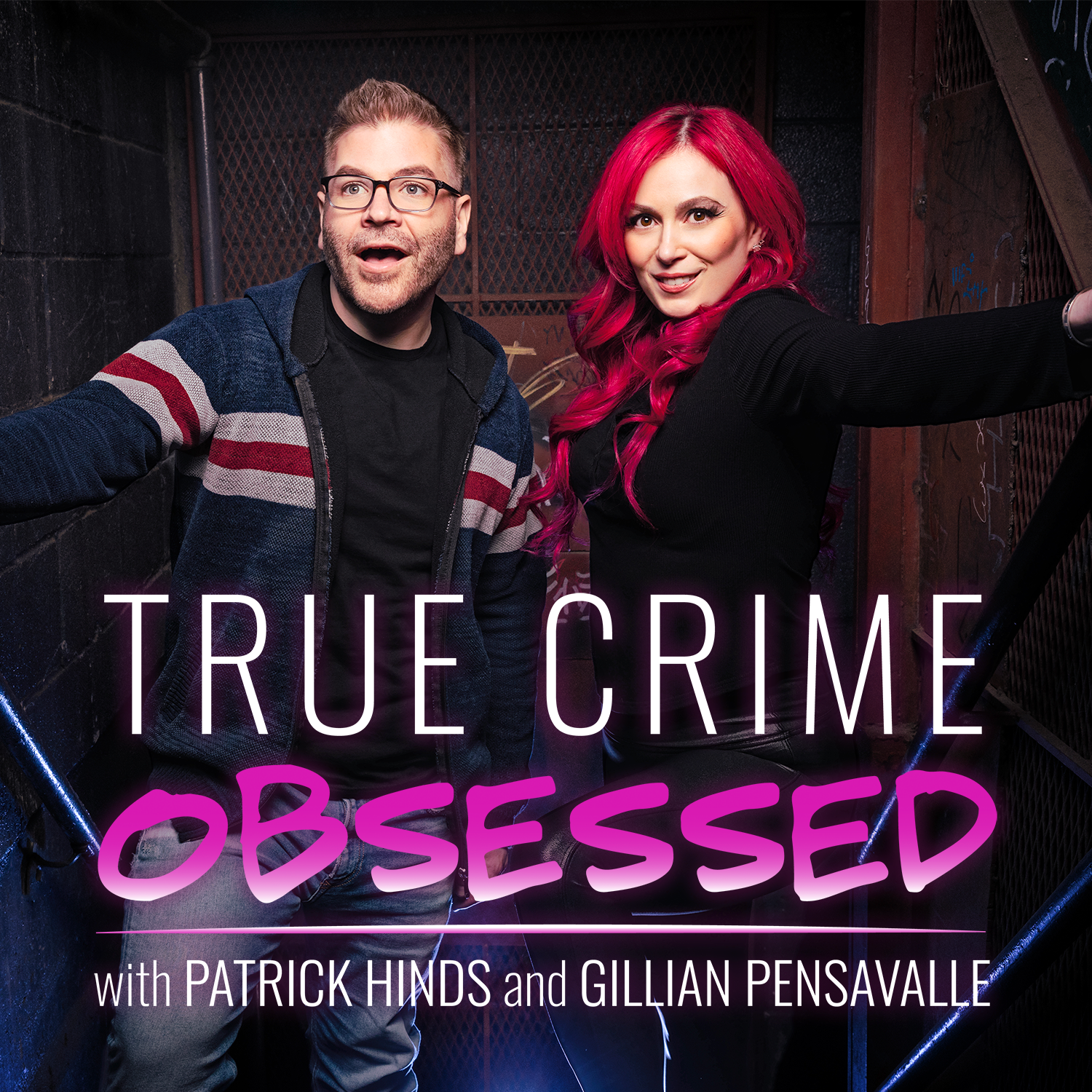
Queen of the Con is built for the moment when a source says something astonishing and the host cannot quite hide his reaction. Its single narrator shifts between composed scene-setting and conversational interviews, greeting strange turns with short bursts of disbelief before stepping back to restore the larger picture. That warmth matters. It gives sources room to wander into the telling detail, then lets the narration quietly reveal how much weight that detail carries.
The show also treats a con as a story with characters rather than a ledger of offences. Episode titles such as The Quarterback and The Con Artist: Ep. 1 announce that human pairing immediately, while The Handyman of West Texas: Ep. 1 opens another character-led arc. Expect measured pacing, vivid introductions and the sense of hearing a complicated account retold by someone still turning it over in his mind.
The Girlfriends moves even closer. Its hosts speak as confidantes, using first-person reflection, sensory scene-setting and interview tape to make the listener feel present in the room where a suspicion first took shape. Short orienting lines keep the story legible, but the emotional rhythm is patient. Hurt, embarrassment and anger are allowed to coexist without being flattened into a lesson about gullibility.
For the most direct route into this subject, The Girlfriends: Spotlight, E23: Anna Catches a Catfish is hard to pass. The Girlfriends S5/Bonus Ep 4: How to Catch a Con-artist points toward the show’s more practical, service-minded mode. Together, the titles capture its useful range: one story can be held as an intimate experience and also examined for the patterns that might help somebody else.
Follow the machinery
Once the charm has done its work, the explanation often becomes more technical. Exit Scam is well suited to that turn. It follows a sprawling fraud through reported interviews and a solo narrator who openly describes the work of checking claims, contacting people and deciding what can be confirmed. Financial jargon is translated quickly, then the investigation moves on.
The tone is dry, lightly skeptical and occasionally self-questioning. Odd details are placed in front of the listener without a theatrical flourish, which makes them feel stranger. This is a good choice for anyone who wants to hear a reporter test a theory in public and remain alert to the possibility that wanting an answer can distort the search for one.
The Missing Cryptoqueen takes a similarly analytical route, though its documentary texture is more immersive. Recorded interviews and document readings share space with a careful narrator who can walk through corporate structures or legal mechanisms without losing the human stakes. Short factual statements break up the denser passages. Ambient sound and scene detail provide breathing room.
Its story is presented as a long trail rather than a quick reveal. Episodes including 13. The South Africa Connection, 14. The Cablecar, 15. Pac-Man and 16. Off the Record signal the serial shape: this is listening for people who enjoy staying with an investigation as its geography and unanswered questions expand.
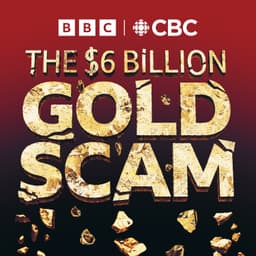
Then there is The Six Billion Dollar Gold Scam, the sternest option of the group. Its documentary voice is controlled and evidence-led, arranging interviews, documents and contradictions into a case that accumulates pressure gradually. The narrator does not rush past procedural inconsistencies or force every strange image into an instant verdict.
That restraint makes it particularly effective for listeners more interested in confidence schemes than romantic betrayal. Mining, finance and forensic detail can become complicated, yet the language stays accessible. The pleasure lies in watching skepticism become structure.
Beyond the con
If fraud is only one part of what you want, you're best off heading to the broader True Crime page. Missing Persons shifts attention from persuasion and financial manipulation toward disappearance and the search for someone absent. Wrongful Conviction follows failures of evidence and justice, while Serial Killers centres repeated violent crime rather than the social engineering of a con.
Those distinctions matter because confidence stories produce their own peculiar suspense. The central question is often less “Who did it?” than “How long can this explanation continue to work?” A good series lets the answer change as trust erodes.
Where to start
Begin with The Girlfriends and The Girlfriends: Spotlight, E23: Anna Catches a Catfish for the closest match to romantic deception. Choose Queen of the Con and The Quarterback and The Con Artist: Ep. 1 for warm, character-driven narration with room for interview tangents. To hear the reporter's reasoning alongside the case, pick Exit Scam. For a patient, document-heavy investigation, go to The Missing Cryptoqueen; for the most restrained evidence-first treatment, start with The Six Billion Dollar Gold Scam.
Featured shows below are part of the PlayNext catalog. Updated weekly.
Featured shows
8 shows, described rather than listed
Each has a written blurb stored with the page, with the role its editor gave it on this beat.
The definitive Theranos serialized investigation — ABC News narrative journalism at its most restrained.
OneCoin and the fugitive Ruja Ignatova — an investigation still running as of early 2026.
QuadrigaCX and Gerald Cotten — a cold-wallet mystery that may never be fully resolved.
Multiple serialized con-artist arcs under one feed — Irish heiresses, quarterbacks, and California grifters.
Intimate first-person narrative following women in extraordinary situations, including relational fraud.
Conversational true-crime anthology with consistent romance-scam and catfishing coverage.
Host of the Snowball Pacific-Island fraud arc; December 2025 episode examines the psychology of why scams work.
Bre-X and the fabricated Borneo gold deposits — a 1990s fraud that briefly fooled the entire mining industry.
Where to start
5 routes in, one per reader
The Theranos story is the most complete serialized fraud case available — a clear entry before any other show on this slate.
OneCoin is the better entry than QuadrigaCX for a first crypto-fraud series — larger scale, fugitive still at large, investigation still active.
Broadest coverage of catfishing and romance-scam cases, updated into 2025 with multiple recent episodes.
Each arc is self-contained and the host's narrator voice is the through-line — designed for exactly this listener.
Shame, Scams, and The Stories We Tell Ourselves (December 2025) is the most direct examination of victim psychology on this slate.
Glossary
Words this beat uses without explaining
Any scheme in which the fraudster first gains the victim's trust (confidence) before exploiting it — the broader category that includes romance scams, investment fraud, and impersonation cons.
A fraud in which an operator of a financial platform absconds with customer assets, sometimes staging a death or disappearance to forestall recovery efforts.
Cryptocurrency storage that is not connected to the internet, making it highly secure but also inaccessible if the owner's private key is lost or withheld.
Creating a false online identity to deceive a target — typically in a romantic context, though the same technique appears in celebrity impersonation and financial fraud.
A fraudulent investment operation in which returns to existing investors are paid using funds from new investors rather than from genuine profit — named for Charles Ponzi's 1919–1920 scheme.
A confidence fraud conducted through online dating or social media in which the fraudster builds a fake romantic relationship to extract money, gifts, or personal information from the target.